
X

LASCIACI I TUOI DATI PER SCARICARE LA SCHEDA PRODOTTO

Calcola: 7 x 2 =
Confermo di aver preso visione della privacy policy
X

LEAVE US YOUR DATA TO DOWNLOAD THE PRODUCT SHEET

Calculate: 7 x 2 =
I confirm that I have read the privacy policy

Tips for choosing a centrifugal pump

When choosing a centrifugal pump you need to take several aspects into account, whether technical or not. Context of use and other variables can, in fact, affect the choice of the most appropriate model.

Let’s take a deeper look at these factors.

Choosing a centrifugal pump: What you need to know

First things first: if you want to avoid wear and corrosion problems, you have to consider the kind of liquid you want to move. Find out what the liquid’s chemical characteristics are, including viscosity and presence of any solid particles, so you have no hesitations about the ideal pump you need and its operation.

Depending on the specific application, you will also have to consider pump sizing, in other words, the amount of liquid in the use cycle. This is an important factor in order to optimise costs.

Assessing the pump and system’s technical characteristics

Delving deeper, a centrifugal pump is made up of fixed parts and moving gears that generate a circular motion at a certain speed. The first characteristics to look at are its flow rate and head.

Flow rate is the volume of water that moves inside the pump expressed in seconds or minutes; head is how high (maximum) the pump has to lift the liquid from the point of intake.

The system, on the other hand, is mainly made up of the pump drive motor, suction and discharge pipes, filters, valves, and the pump’s priming and drainage systems.

Pump types

From vertical pumps to horizontal pumps, these tools find application across many sectors and businesses, from industry to agriculture, through to private uses.

Let’s start with steel submersible pumps, which are widely used in industry and for irrigation. These pumps are easy to install and feature submersible motors and built-in check valve. They come in two versions:

  • radial flow, for limited flow rates and high pressures;
  • semi-axial flow, for high flow rates and medium pressures.

Cast iron submersible pumps are similar to these and have a great power level. They are also driven by a submersible motor and equally versatile across fields of application in terms of liquid supply.

Split case pumps are another interesting solution. With their separate chamber, they are innovative from both a technical and maintenance standpoint. In fact, since the pump casing is axially split, the rotor can be worked on without meddling with the motor or pipes.

Do you want our advice about which centrifugal pump to choose? Contact us now! We’ll be happy to help.
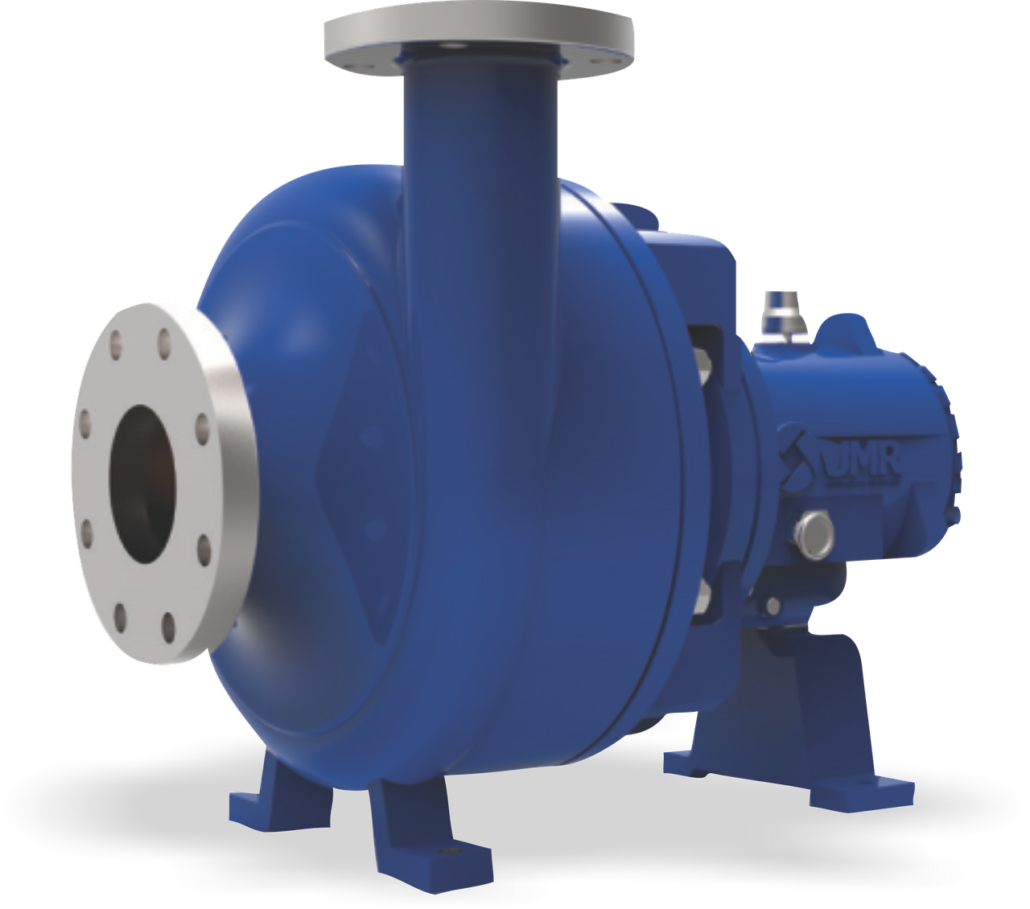
 

Difference between centrifugal and positive displacement pumps

Centrifugal and positive displacement pumps are tools that play a key role in today’s industry. Their function lies in the ability to transfer fluid from one point to another, be the level high or low. However, they differ in the way they work and the type of fluid moved. 

Pump classification

centrifugal pump

A macro breakdown immediately comes to mind when we think of pump classification, one that helps us to better understand the difference between centrifugal and positive displacement pumps. This breakdown regards, first of all, the fluid pumping method:

  • Hydraulic pumps
  • Positive-displacement pumps

In the first case, the pumping action is achieved by the fluid’s dynamics whereas in the second, it is achieved by the variation in volume. Centrifugal pumps fall in the first case.

Centrifugal pumps and positive displacement pumps in detail 

Centrifugal pumps use an impeller to activate a centrifugal effect that moves the water (or other liquid) and converts mechanical energy into kinetic energy; the latter thus exerts strong pressure on the fluid, displacing it.

In terms of the level of the intake, centrifugal pumps clearly have to pump the liquid from a lower to a higher point. Underlining this aspect is not trivial because this scenario represents most cases. In fact, a pump is rarely used to transfer liquids from a higher to a lower point.  

What are the advantages of a centrifugal pump?

Centrifugal pumps are the most commonly used of hydraulic pumps, both in industry and by private individuals, but also in farming (such as the centrifugal pumps for irrigation systems).  


Displacement pumps generate energy periodically. As already mentioned, they use the variation in volume to produce suction or thrust of the water. These include rotary pumps and reciprocating pumps and are used for higher-density fluids.


Because of the way these pumps function, pump manufacturers, businesses and institutions have come to understand the significance of pumps for solving environmental issues. Are you aware of their use in this area? Contact us to learn more. 


How does a centrifugal pump work?

Pumping systems are becoming increasingly essential in this day and age. Knowing how a centrifugal pump works can therefore solve many issues of an environmental nature, not to mention problems associated with a variety of different work environments.

Centrifugal Pumps Operational characteristics

Pumps are mechanical instruments that increase a liquid’s energy by means of pressure; the design of a centrifugal pump includes stationary components and a mobile gearwheel, the impeller, which rotates at a specific speed.


centrifugal pump

Technically speaking, a centrifugal pump’s impeller is a wheel equipped with vanes; it can be constructed in a variety of ways, depending on the desired function.


Prior to fully examining the components that contribute to its operation, we must consider the preliminary research and design phase, which has a crucial impact on the system’s efficiency. It is during this phase that the sizing of the centrifugal pump takes on particular importance.


Centrifugal pump sizing 


Proper sizing of the centrifugal pump ensures the correct amount of liquid per normal use cycle; it is also important because it is needed to estimate project costs and operating costs. By preventing oversizing, this step reduces costs to a minimum.

Centrifugal pump flow rate, head and power


One of the primary aspects to consider is the flow rate of the centrifugal pump, or, in other words, the volume of the water that passes through it in a given amount of time, expressed in seconds or minutes; this is especially pertinent with regard to the agricultural sector, and specifically when dealing with centrifugal pumps for irrigation.


Head, which is the pressure jump produced by the pump, is closely linked to the centrifugal pump’s flow rate. Head is a measurement that decreases as flow rate increases; it is expressed in metres, and indicates the peak height to which the pump can raise the water with respect to the source point.


Lastly, the power is the energy the system requires in order to continue raising the water’s flow rate and, as such, is directly responsible for the centrifugal pump’s hydraulic efficiency.


POMPE ZANNI SRL UNIPERSONALE Via G. Reni, 5 - 42048 Rubiera (RE) Italy - VAT nr.: 02698600356 - REA Reggio Emilia: n. 305475 - Privacy Policy - Cookie Policy